August 17, 2026 · 7 min read
The First 30 Days With Your AI Assistant: A Week-by-Week Plan
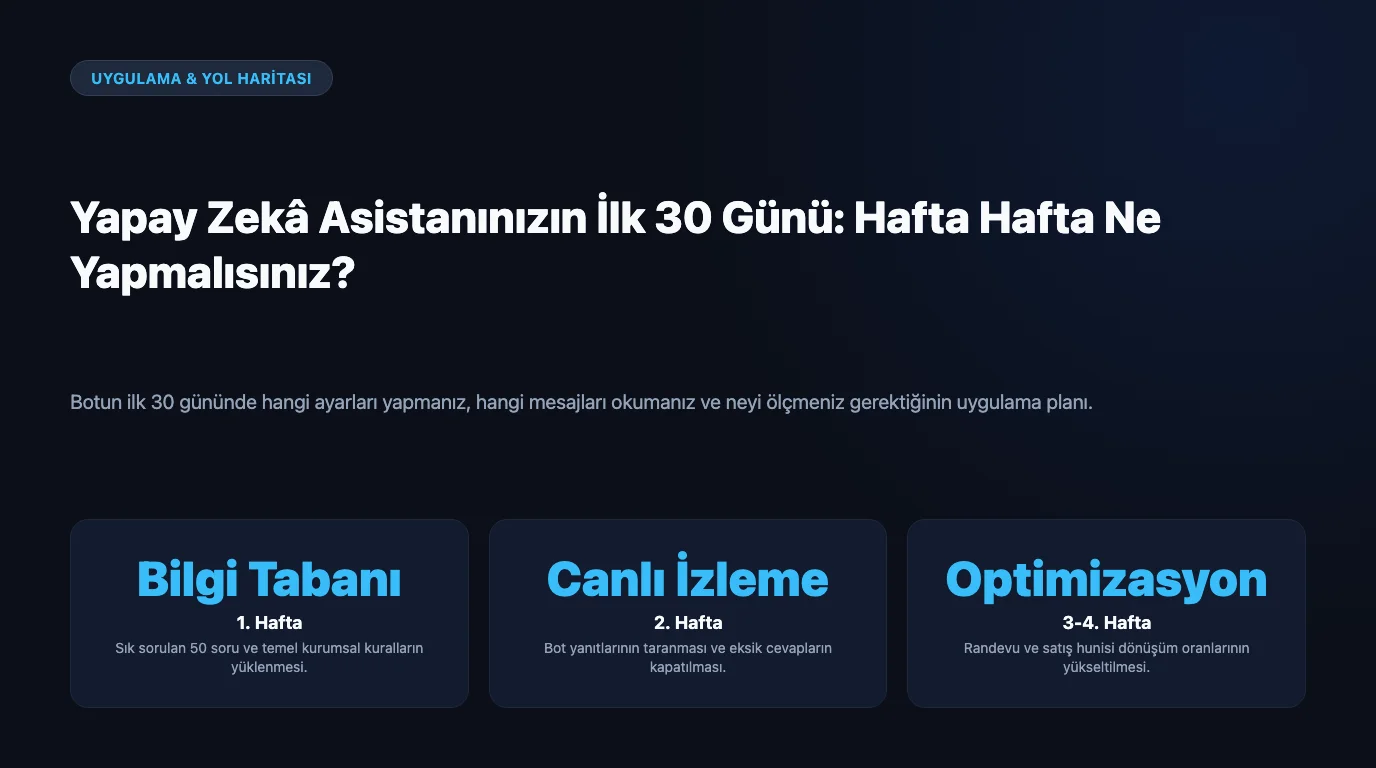
Setting up an AI assistant is like buying a car: the real difference shows up in the first kilometres you drive. The small corrections you make in the first 30 days shape the quality of every answer the assistant gives for the rest of the year. This article splits those four weeks into concrete tasks.
Week 1: Listen, do not change
The first week is for observation, not configuration. Your goal is to see the exact words real customers use. Most businesses discover that customers use entirely different terms than the company does: you say "appointment", they write "do you have a slot", "are you free today".

- Spend 10 minutes each evening reading that day's conversations end to end.
- Keep a separate list of messages where the assistant missed the point or stayed silent.
- Note the words customers use that do not appear anywhere in your documents.
- Do not upload new documents this week; first understand what is missing.
The output of week one is a single list: questions the assistant could not answer. That list is the roadmap for the next three weeks.
Week 2: Feed the knowledge base with real questions
Now you have evidence instead of guesses. Take the unanswered questions and write a short, direct answer for each. Prefer one-paragraph answers over long corporate texts; assistants struggle to find the right sentence inside long, unstructured documents.
- Keep each answer to three or four sentences.
- Collect changeable facts (prices, durations, address, opening hours) in one document so updates are easy.
- Make sure the same fact is not written differently in two documents. Contradictions are the most common source of wrong answers.
- Define what happens when the answer is unknown: which number to point to, when to hand over to a human.
Week 3: Tone and boundaries
Week three is about how the assistant speaks. Response length, form of address and the topics where it must never make promises are decided here. Writing the "never say this" list early prevents most future problems.
- Match response length to the channel: shorter on WhatsApp, slightly more detailed on the website.
- Never let it promise discounts, firm delivery dates, or medical and legal advice.
- Define a direct handover rule for complaints and refunds.
- Write a one-sentence identity: on whose behalf and in what tone does it speak?
Week 4: Measure, compare, simplify
The final week is about numbers. What matters is not "how many messages arrived" but "how many conversations were completed without a human" and "how many ended in an appointment, quote or order".
| Metric | Why it matters | How to improve it |
|---|---|---|
| Conversations completed without handover | Shows the assistant is genuinely carrying load | Add unanswered questions to the knowledge base |
| First response time | Customer patience is short | Keep automatic replies enabled on every channel |
| Conversations that reached an outcome | This is the actual business result | End conversations with one clear next step |
| Repeated identical questions | A sign your website is missing information | Publish the answer on the site too and message volume drops |
By the end of week four you should have two things: a table showing where you are strong, and a short list of information still missing. Month two is about closing that list.
Three common mistakes
- Changing everything in week one: settings made before data are just guesses.
- Uploading a 200-page PDF: assistants struggle to find the right sentence in long, scattered documents.
- Judging success only by "does the bot answer nicely": the real question is how much business it closes.
Businesses that follow this rhythm are ready to expand in month two, adding new channels, appointments or quotes. Those who switch everything on in week one usually spend month two fixing things.
Frequently Asked Questions
Related Articles
7 min read
What is RAG? Guide to Accurate AI Chatbot Responses
What is RAG (Retrieval-Augmented Generation)? The architecture that prevents AI chatbot hallucinations and ensures 100% accurate responses.
6 min read
Serving Foreign Customers with Multilingual AI Chatbots
Serve foreign customers 24/7 in their native languages. Discover the benefits, limitations, selection criteria, and setup steps of multilingual AI chatbots.
8 min read
When Your AI Assistant Invents Answers: Preventing Hallucination
How to stop a customer-facing AI assistant from inventing discounts, quoting wrong prices or promising services you do not offer: grounding, refusal paths and adversarial testing.
Ready to set up an AI assistant for your business?
View Pricing