August 17, 2026 · 6 min read
Why Does Your Bot Sound Like a Robot? 9 Fixes for a Natural Tone
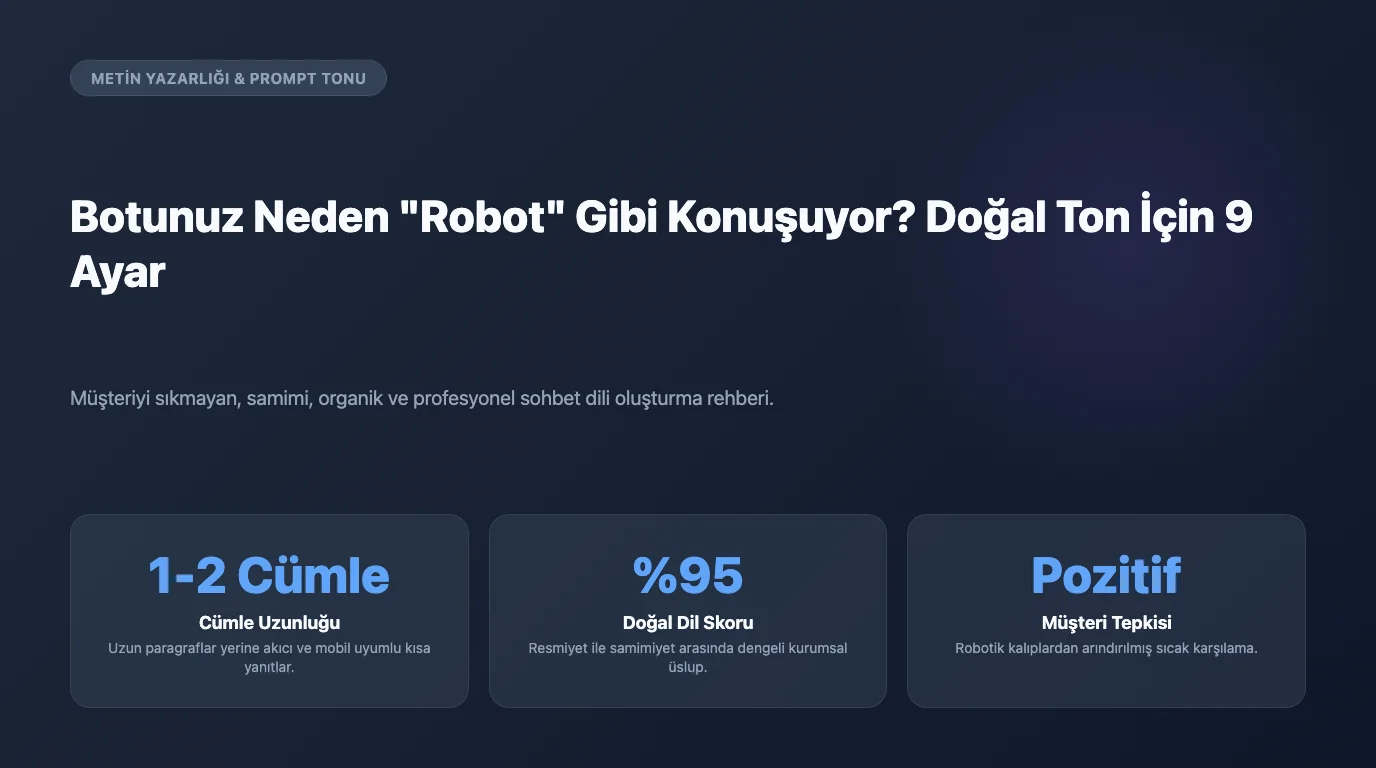
The most common complaint about an AI assistant is not that it answers incorrectly, but that it "sounds like it is reading from a script". An assistant that gives correct information in canned phrases creates distance instead of trust. The good news: this feeling is fixed with a handful of writing rules.
1. Do not repeat the greeting in every message
People say hello once per conversation. An assistant that starts every reply with "Hello, how may I help you?" earns the robot label within three messages. Greet only in the first reply.
2. Start with the answer, not with yourself
Instead of "Regarding your question, I would like to inform you that appointments last 30 minutes", write "Appointments take 30 minutes." The customer is looking for the answer; a preamble delays it.
3. Ban corporate filler
- "Dear valued customer", no real person speaks like this.
- "Your request has reached us", passive and distant.
- "Your satisfaction is important to us", carries no information.
- "Please be informed", formal letter language, not conversation.
Adding these to a "never use" list humanises the tone in one move.
4. Match length to the channel
Three paragraphs on WhatsApp means scrolling on a phone. Two or three sentences is right for messaging channels; if detail is needed, answer briefly first and ask "want me to explain in detail?".
5. Borrow the customer's words
If the customer wrote "how much", answer with "price", not "fee structure". Speaking closer to the customer's language beats technically correct but unfamiliar vocabulary.
6. Use emoji sparingly
One emoji per reply is plenty. Emoji exist to soften tone, not to decorate. Use none in complaint or refund conversations.
7. Say honestly when you are unsure
"I cannot confirm that for certain, let me pass this to our team right away" builds far more trust than an invented answer. Write the uncertainty sentence yourself instead of leaving it to chance.
8. End every reply with one step
Natural conversation moves forward. Close with a single clear step: "Does 2 pm tomorrow work?" or "Shall I send the address?" Offering three options makes deciding harder.
9. Read your reply out loud
This is the simplest test. Would you speak like this to a customer on the phone? If not, shorten the sentence. It gives faster results than any long list of rules.
A short comparison
| Robotic tone | Natural tone |
|---|---|
| Dear valued customer, your request has reached us. | Got it, looking into it now. |
| I would like to inform you about our appointment processes. | Appointments take 30 minutes. |
| Your case will be directed to the relevant department. | I am passing this to Ayşe, she will write shortly. |
| Your satisfaction is important to us. | Sorry about the delay you experienced. |
A natural tone comes from using fewer stock phrases, not from a smarter model. Apply these nine fixes and reread your own conversations a week later; you will not need another metric to see the difference.
Frequently Asked Questions
Related Articles
6 min read
Preparing a Chatbot Knowledge Base: Practical Guide
How to structure a company knowledge base to train an AI chatbot? Document formatting, FAQ design, and maintenance.
10 min read
Voice AI Assistant: Inbound Call Management Guide 2026
What is a voice AI assistant and how does it work? ASR, LLM and TTS layers, latency, pronunciation quality, warm transfer, cost model and which businesses it actually suits.
8 min read
When Your AI Assistant Invents Answers: Preventing Hallucination
How to stop a customer-facing AI assistant from inventing discounts, quoting wrong prices or promising services you do not offer: grounding, refusal paths and adversarial testing.
Ready to set up an AI assistant for your business?
View Pricing