July 11, 2026 · 8 min read
WhatsApp Chatbots and KVKK Compliance: Business Guide

When business leaders evaluate intelligent customer communication assistants, their most essential question is: “Do automated WhatsApp customer chats and data handling create legal liability under Turkish Personal Data Protection Law (KVKK) or European GDPR?” The answer is unequivocal: A well-architected AI assistant fully complies with data privacy laws provided the business implements required transparency, data minimization, and secure processing safeguards.
Which Personal Data Does the Chatbot Architecture Process?
- Identity & Contact Details: Full name and phone number (inherent to the official WhatsApp messaging protocol).
- Message Content & Inquiries: Appointment requests, pricing inquiries, service questions, and voluntary information submitted by the user.
- Transaction Logs & Audit Timestamps: Communication timestamps, booking confirmations, and consent acknowledgment records.
Under data protection legislation, your business remains the “Data Controller,” while the AI technology provider acts as the “Data Processor” executing instructions on your behalf. This responsibility model mirrors traditional phone operations, but with significantly enhanced encryption and audit trail capabilities.
5 Core Privacy Principles for Corporate Chatbots
| Privacy Principle | Practical Implementation |
|---|---|
| Mandatory Disclosure Notice | Delivering a concise data disclosure notice and privacy policy URL in the initial greeting |
| Purpose Limitation | Never utilizing contact numbers gathered for bookings for unsolicited promotional campaigns |
| Data Minimization | Restricting the assistant from requesting sensitive identifiers such as National ID numbers |
| Technical Security | Deploying AES-256 data encryption with strict role-based internal access controls |
| Right of Erasure | Supporting automated or manual deletion of client conversation transcripts upon request |
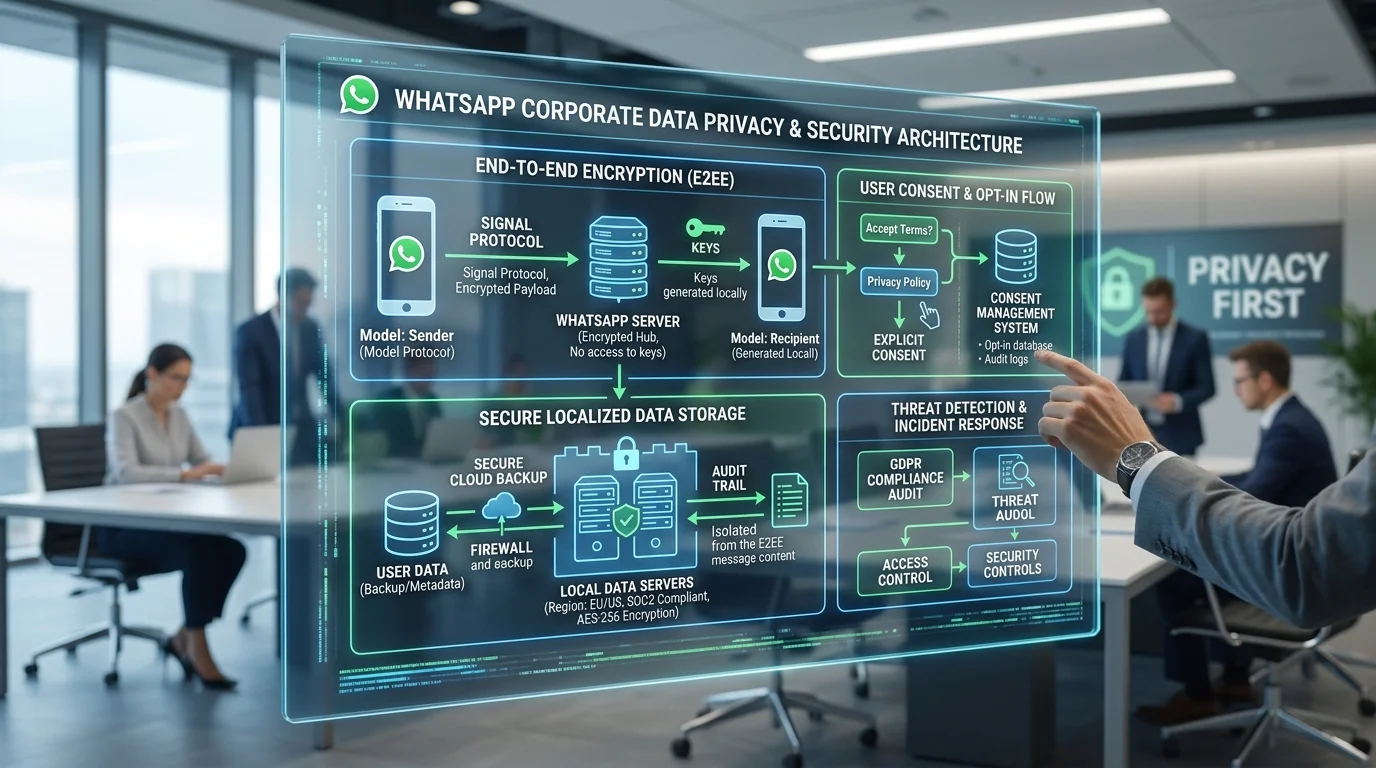
Enterprise AI Isolation & Zero Model Training
The most critical security question every enterprise must verify is: “Are our proprietary client conversations shared into public model training datasets?” With BozLat AI, your customer dialogues are never used to train external foundational LLMs. Responses are generated strictly within your segregated private knowledge base, guaranteeing strict tenant isolation.
4 Security Questions to Audit Any AI Provider
- Where is customer data physically hosted, and is data in transit and at rest encrypted?
- Does the vendor execute a legally binding Data Processing Agreement (DPA)?
- What is the verified technical workflow when a client exercises the right to data deletion?
- Does the AI safely escalate unverified inquiries to human agents rather than hallucinating answers?
Review our security commitments in our privacy policy, and discover specialized healthcare compliance guidelines on our clinic industry page and pricing page.
In fields carrying heavier confidentiality obligations, such as professional privilege, the configuration needs even more care; for boundaries specific to law firms see our AI assistants for law firms guide.
Frequently Asked Questions
Related Articles
7 min read
Chatbot Security: Prompt Injection and Data Leakage
How to protect AI chatbots against Prompt Injection and malicious manipulation? Enterprise data protection and security guide.
10 min read
WhatsApp Opt-in: Compliant Consent Collection Guide
How do you collect consent for WhatsApp marketing messages? Valid opt-in methods, what the consent text must contain, record keeping, opt-out handling and common mistakes.
10 min read
Voice AI Assistant: Inbound Call Management Guide 2026
What is a voice AI assistant and how does it work? ASR, LLM and TTS layers, latency, pronunciation quality, warm transfer, cost model and which businesses it actually suits.
Ready to set up an AI assistant for your business?
View Pricing