August 17, 2026 · 5 min read
Does Saying "I am a bot" Hurt Sales?
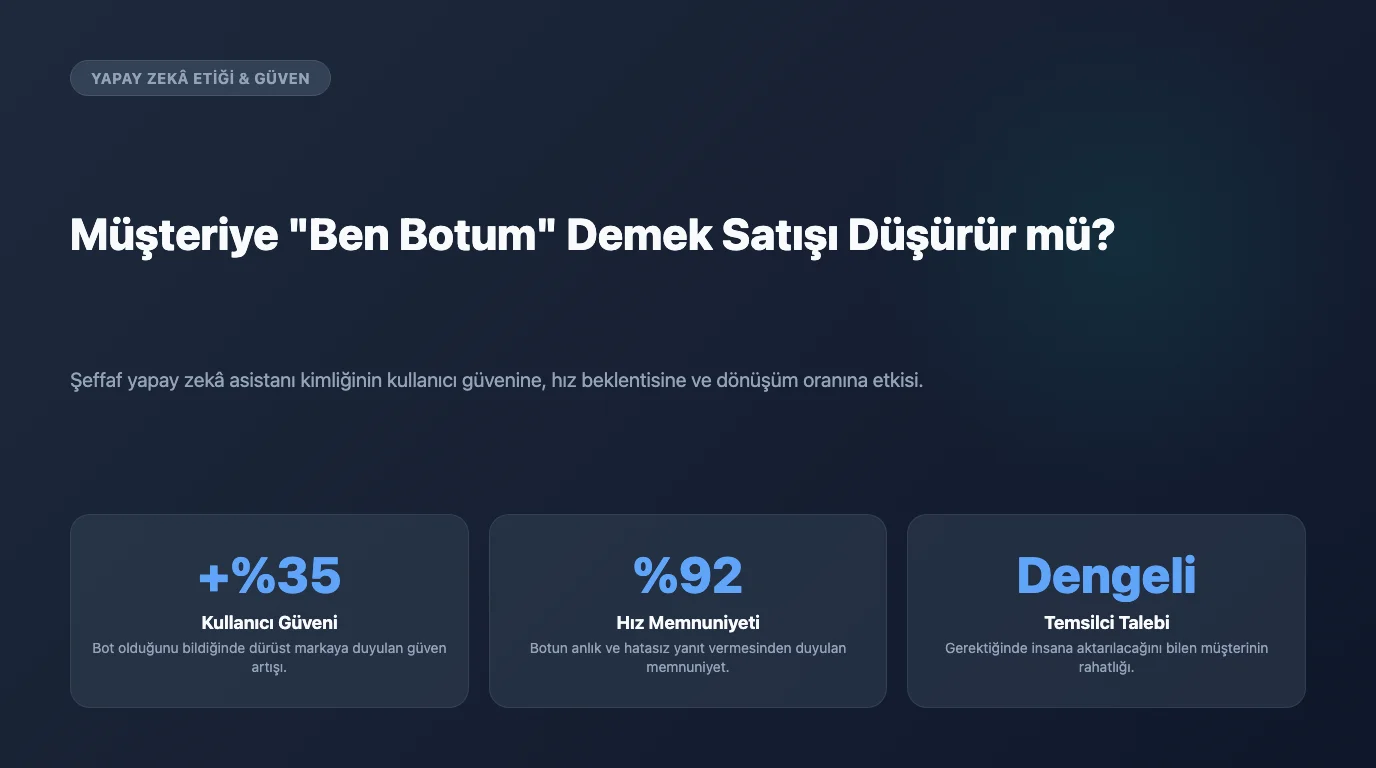
Businesses adopting an AI assistant share the same first worry: "if customers realise it is a bot, will they take us less seriously?" In practice, customers work it out within a few messages. The real question is whether they learn it from you or from their own guess.
The cost of hiding
When a customer discovers it alone, two things happen at once: trust in the conversation drops and they start questioning the information given. An identity stated upfront sets expectations correctly instead. Being caught pretending is more expensive than disclosing.
How to phrase it
| Weak | Strong |
|---|---|
| "I am an artificial intelligence bot." | "I am the AI assistant of ..., I can answer your questions right away." |
| "Automated message." | "I am here 24/7; I can connect you to Ayşe from the team if needed." |
| (says nothing) | "I am an AI assistant. I can help with appointments and pricing." |
The strong versions share one trait: they state the identity and the usefulness in the same breath. Customers do not leave because they heard "bot"; they leave when they do not know what it can do.
When disclosure is mandatory
- Healthcare, law and finance, where advice has consequences.
- Binding actions such as payment, cancellation and refunds.
- When asked directly: never give a misleading answer to "are you human?".
- Complaint conversations: people want to feel heard, so handing over to a person is the better call.
Three behaviours that build trust
- Knowing its limits: "I cannot confirm that, I am passing it to the team" increases trust.
- Easy escalation: the customer must reach a real person whenever they want.
- Consistency: giving the same answer to the same question over time matters more than identity.
So what about sales?
What shapes the experience is whether the job gets done, not whether the bot introduced itself. A customer who books in 30 seconds does not mind talking to AI. The same customer forced to repeat themselves three times leaves unhappy even if a human was on the other side.
In short: hiding the identity does no harm in the short term but collapses trust the moment it is noticed. Stating it openly sets expectations and protects you when the assistant makes a mistake.
Frequently Asked Questions
Related Articles
12 min read
Chatbot KPIs: Key Metrics You Must Track
What is a chatbot KPI and how is it calculated? Formulas and target ranges for deflection, containment, response time, handover, CSAT and cost per conversation.
8 min read
AI Assistant vs. Human Secretary: An Honest Comparison
Compare AI assistants and human front-desk staff: explore cost realities, emotional intelligence limits, and the optimal hybrid operational model.
6 min read
Designing Chatbot-to-Human Agent Handover
When should an AI chatbot transfer a conversation to a live customer support agent? Human-in-the-loop architecture and smooth agent takeover.
Ready to set up an AI assistant for your business?
View Pricing