August 17, 2026 · 6 min read
AI Sales Conversations: Pricing Questions and Lead Qualification
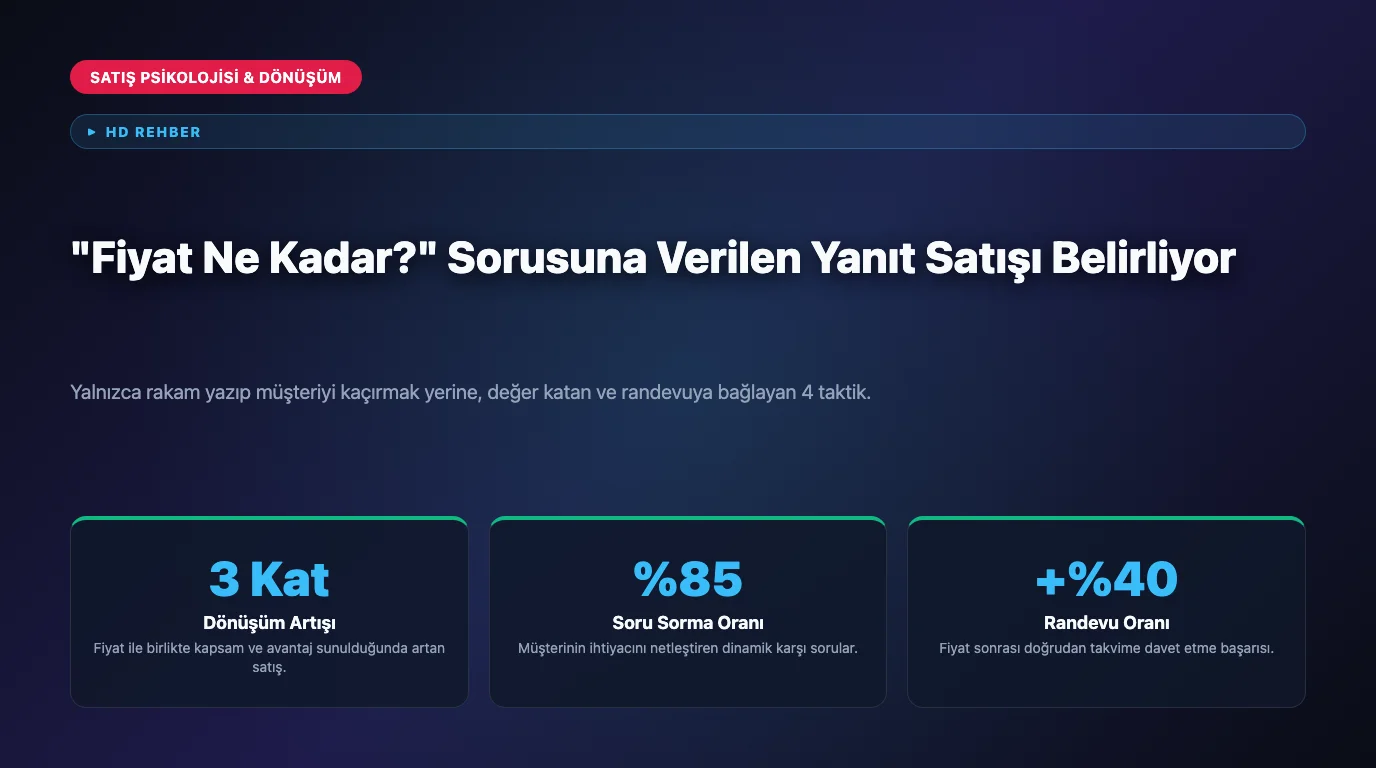
"How much is it" tops the list of first messages. The question is less simple than it looks: customers are usually asking whether this is right for them, not just for a number. Your answer decides whether the conversation turns into a sale or into silence.
Four types of answer
| Type | Example | Usual outcome |
|---|---|---|
| Evasive | "Prices vary, please call us." | Conversation ends, customer writes to a competitor |
| Bare number | "1,500 TRY." | Comparison starts, haggling gets easier |
| Range + scope | "Between 1,200-1,800 TRY; the difference comes from ..." | Expectations settle, conversation continues |
| Range + one question | "1,200-1,800 TRY. How many people is it for?" | Conversation turns into qualification |
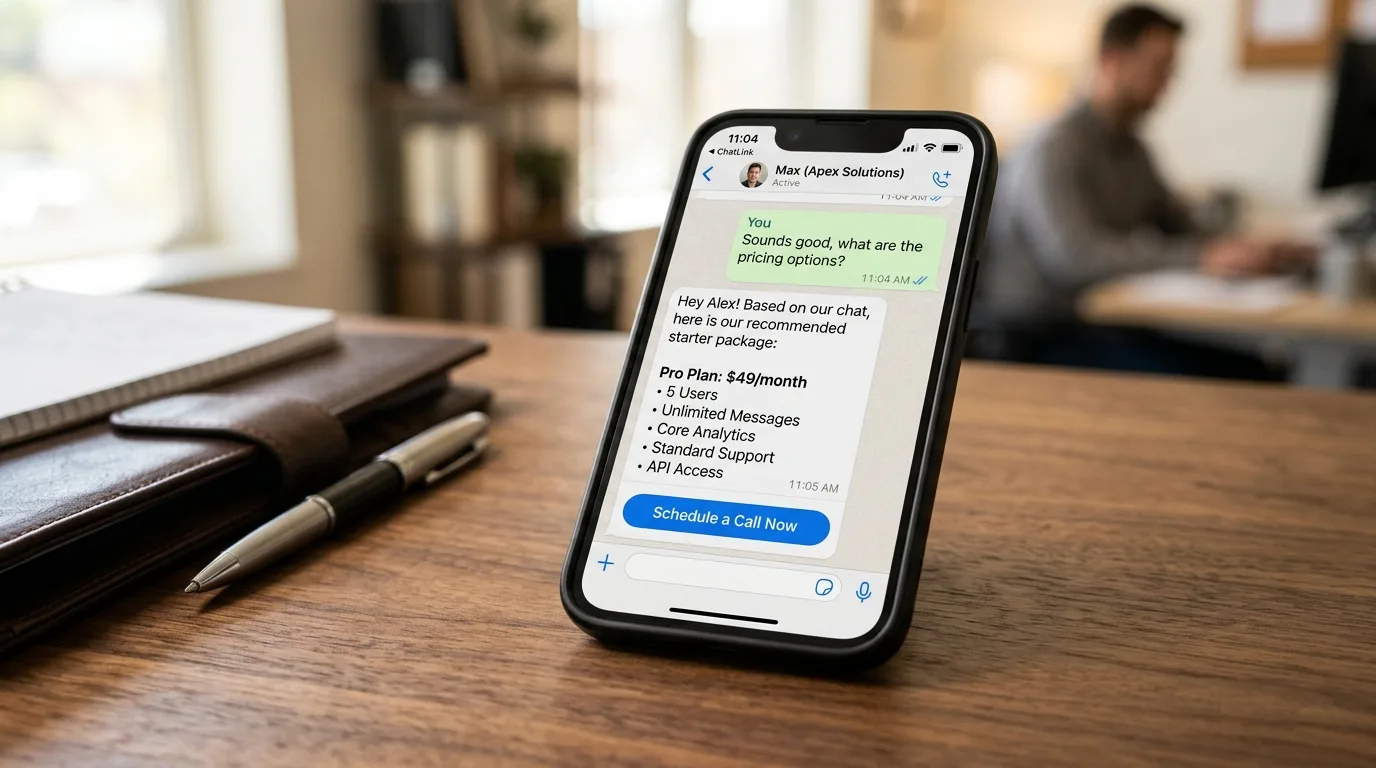
Experienced salespeople use the fourth line: they do not hide the number, but they also do not end the conversation with it.
Why hiding the price fails
The idea behind withholding price is "let me explain the value first". On messaging channels this rarely works, because the customer has written to three businesses at once. The one who does not answer is eliminated first. Worse, silence usually creates the assumption that you are expensive.
How to give a range properly
- Keep the range narrow: 1,200-1,800 TRY inspires far more confidence than 1,000-5,000.
- Explain the difference in one sentence: duration, scope, materials, number of people.
- Clarify what the lower bound includes so nobody is disappointed later.
- Ask exactly one question right after the number; keep the conversation moving.
How should an AI assistant handle price?
The assistant needs two abilities: knowing the right range and knowing its limits. If a firm price requires variables to be settled, it should say so plainly and ask for what is missing. An invented number does not save the sale; it becomes an objection later.
- Keep the price list in a single document so the assistant reads the current figure.
- Never grant discount authority to the assistant. Negotiation is a human decision.
- Update the answer to "is there a promotion right now" at every campaign.
- Define a flow that moves from the price question to an appointment or a quote.
What to say when they call it expensive
"That is expensive" is usually a request for justification rather than an objection. The right reply is not defensiveness but a reminder of scope: what is included, how long it takes, whether there is a guarantee. A customer who still walks away after that was never your customer.
A small habit
For one week, mark every conversation that starts with a price question and check how many ended in an appointment, quote or order. That ratio is the most honest measure of your price answer; track how it moves when you change the wording.
B2B Lead Qualification with AI Chatbots
AI chatbots automate B2B Lead Qualification, filtering out unqualified leads and passing sales-ready prospects directly to account executives.
Automated BANT Qualification
| BANT Pillar | Evaluation Objective | Sample Bot Inquiries |
|---|---|---|
| Budget | Is the project budget aligned with enterprise pricing? | 'What budget range is allocated for this initiative?' |
| Authority | Is the interlocutor an authorized decision maker? | 'What is your role/title in the procurement process?' |
| Need | What exact operational pain points require resolution? | 'Which specific capabilities and integrations are required?' |
| Timeline | When is target implementation scheduled? | 'What is your planned go-live launch timeframe?' |

See our guide on WhatsApp CRM integration and live agent transfer.
Automated B2B Lead Routing with BozLat AI
12 Questions to Ask Before Buying an AI Assistant
AI assistant demos run smoothly: prepared questions, prepared answers. The real difference hides in the details that surface after the contract. These twelve questions are the shortest, highest-value preparation you can do before buying.
Data and ownership
- Where are customer conversations stored, and in which country?
- If the contract ends, in what format and how quickly can I take my data?
- Are my conversations used for model training? Can that be turned off?
- What is the process when a customer requests deletion of personal data?
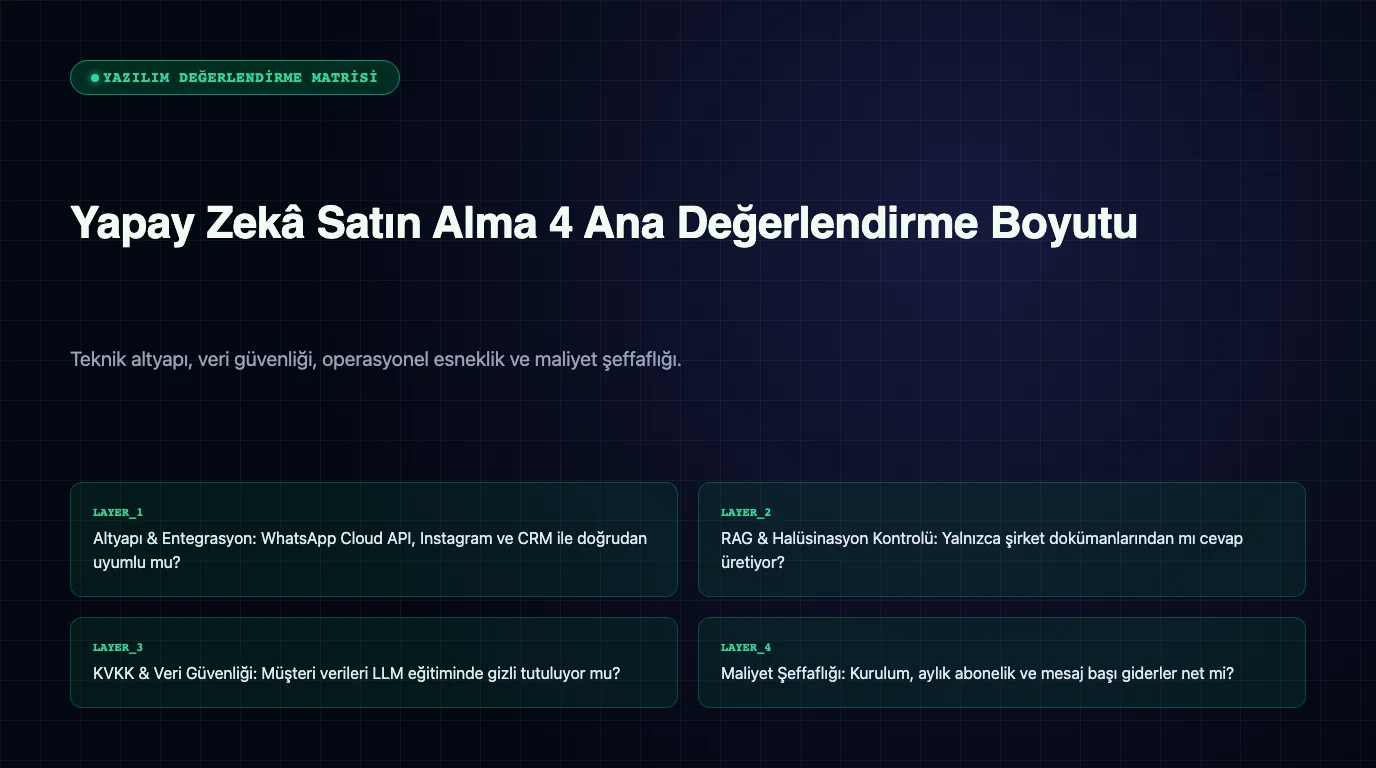
If these four do not have clear answers, stop there. Data ownership is the hardest thing to fix later.
Capability and limits
- 5. Which channels are supported, and do WhatsApp, Instagram and the website share one knowledge base?
- 6. Can I update the knowledge base myself, or does every change require a support ticket?
- 7. How do I define the handover rule; can a customer reach a human instantly on request?
- 8. Can it talk to my calendar, order or stock system?
Question six is critical: if you cannot update the knowledge base yourself, every price change makes you dependent on the vendor.
Cost items
| Item | Question to ask |
|---|---|
| Setup | What does the one-off fee include, how many revisions? |
| Subscription | What drives the price: messages, conversations, seats? |
| Channel fees | How do WhatsApp conversation charges appear on the invoice? |
| Model usage | Is the model that generates answers included or billed separately? |
| Overage | What happens past the limit: service stops or extra charges? |
9. Can I see a sample monthly invoice covering all five items? This single question surfaces most surprises early.
Continuity and exit
- 10. What happens during an outage: are messages lost or queued?
- 11. When and through which channel is support available, and is there a response time commitment?
- 12. If I leave, do I keep my number, knowledge base and conversation history?
Run the demo with your own questions
Instead of the vendor's scenario, use your hardest cases: your three most common customer questions, one complaint, and a deliberately vague message ("are you free tomorrow maybe"). Watching how it behaves with incomplete information teaches far more than a scripted demo.
Final check before deciding
Before you decide, request three things in writing: the data retention and deletion policy, a sample monthly invoice, and the data handover timeline on exit. A vendor who struggles to provide these will struggle with bigger things later.
Frequently Asked Questions
Related Articles
8 min read
Cost of Missed Customer Inquiries: Revenue Loss Formula
Calculate the hidden monthly revenue loss from unanswered WhatsApp messages, missed phone calls, and slow social DMs, and plug the pipeline leak.
7 min read
How WhatsApp Business API Pricing Actually Works
How is a WhatsApp Business API bill formed? Category-based pricing, free cases, hidden cost items, and practical ways to keep the budget under control.
7 min read
Call Center vs WhatsApp Automation: Cost Comparison
Comparing traditional phone call centers vs WhatsApp AI messaging automation in terms of cost, speed, and efficiency.
Ready to set up an AI assistant for your business?
View Pricing